

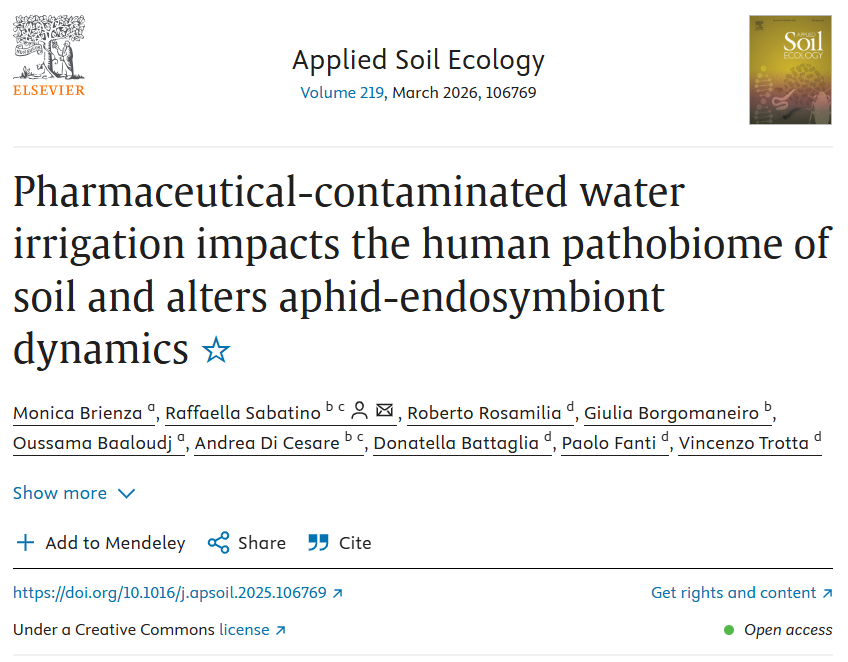
The NEWater team reports a new open-access study in Applied Soil Ecology that follows the effects of very low, environmentally realistic concentrations of pharmaceuticals in irrigation water across the soil–plant–insect continuum. Using a controlled zucchini–cotton aphid model, the authors combined high-resolution soil microbiome profiling with plant growth measurements and insect biology, including quantitative assays of aphid endosymbionts. The central signal is subtle but consistent: overall soil diversity remains broadly stable, yet community composition shifts toward genera associated with opportunistic pathogenicity, while aphids feeding on treated plants show a marked reduction in beneficial endosymbionts even when survival and fecundity appear unchanged. These findings point to an ecological reconfiguration that standard growth-only endpoints would miss, highlighting the value of coupling microbial, agronomic, and cross-trophic indicators in water-reuse safety assessments.
Why this matters
As regions scale up circular water strategies, decision makers need early indicators that reveal biological change before visible agronomic impacts. The study suggests that trace pharmaceutical mixtures can quietly reorganize the below-ground community and alter insect microbial partnerships without triggering immediate yield penalties. Monitoring palettes that include soil pathobiome composition, conservative antibiotic-resistance proxies, and insect symbiont status can provide earlier and more actionable signals than bulk chemistry alone. For NEWater, this evidence strengthens the case for risk-aware reuse frameworks that are practical for operators yet sensitive to low-level ecological change, ensuring reclaimed water remains safe and beneficial in real agricultural contexts.
Study overview
The experimental design mimicked routine irrigation with a realistic mixture of commonly detected pharmaceuticals at very low concentrations. Plants were grown under controlled conditions to isolate treatment effects, soils were profiled through 16S rRNA amplicon sequencing to capture community structure, and a widely used genetic marker was tracked as a proxy for antibiotic-resistance selection. Plant biomass and leaf number were measured alongside aphid performance across generations, and aphid endosymbionts were quantified to reveal internal microbial responses. Taken together, these layers show that community composition can drift toward taxa of concern while classical resistance markers and crop performance remain steady, and that insect symbionts provide a sensitive readout of plant-mediated exposure.
Implications for safe reuse
Utilities and farmers adopting reclaimed water can use these insights to refine monitoring and treatment choices. If early microbiome signals indicate a drift in the soil pathobiome or a decline in beneficial insect symbionts, operators can adjust polishing steps or operational parameters before agronomic performance deteriorates. Integrating microbiome composition, sentinel resistance markers, and cross-trophic indicators into routine surveillance will improve the precision of risk management while keeping costs and logistics realistic for Mediterranean agroecosystems and beyond.