

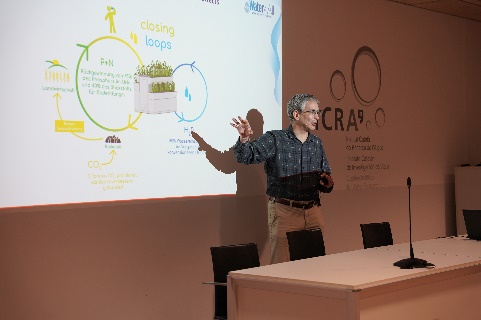
On 17 September 2025, the Catalan Institute for Water Research (ICRA) in Girona hosted the mid-term workshop of the NEWater Project under the title “Nature-Based Solutions for Water Reuse: Sustainable Systems Supporting Agriculture and Circular Economies”. The event, held in a hybrid format with over 70 participants, brought together leading researchers, industrial partners and practitioners to explore how nature-based solutions (NBS) can drive water reuse, agricultural resilience and circular economy models.
The workshop featured presentations from multiple project partners including Alchemia‑nova, Sorigué, Águas do Tejo Atlântico, the CWP Cluster and the universities of Basilicata (Italy), IDR/Montpellier (France) and Ibn Tofaïl (Morocco).The agenda fostered an exchange across academic, industrial and institutional stakeholders, focusing on the deployment of nature-based treatment systems, decentralized water reuse, and enabling circular flows linking water, energy, nutrients and agriculture.
Key themes addressed included:
- the role of nature-based solutions in treating non-conventional water streams (urban wastewater, greywater, agricultural runoff) and converting them into safe, reusable water streams for irrigation and industry.
- the integration of agricultural systems with water reuse practices, enabling resilience against water scarcity while advancing circular economy concepts.
- governance, business models and cost-energy efficiency considerations, given that NEWater’s aim is to develop energy- and cost–efficient hybrid biological, physical and nature-based water treatment systems.
- advancing nature-based solutions to meet EU regulatory requirements (e.g., EU Regulation 2020/741) and emerging contaminant challenges (e.g., pharmaceuticals, endocrine-disrupting compounds) in reuse applications.
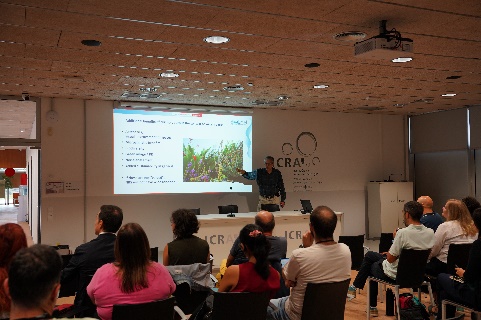
The hybrid format enabled both in-person attendees at ICRA’s “H₂O Building” and remote participants to engage in plenary and breakout discussions, promoting international collaboration and cross-fertilisation of ideas.The workshop thus marks a major milestone for NEWater in consolidating its mid-term findings and shaping the path to demonstration scale and market uptake.
For the NEWater consortium, the event served not only as a dissemination and networking forum but also as a checkpoint to refine upcoming work packages and align partners on the next phase of implementation, ensuring that the nature-based systems under development can be validated, replicated and scaled across various European and non-European contexts